Turkish to Arabic Translation: What MT Got Right and Missed

A note before you read this: the client, the brief, and the source article in this post are all fictional. I created them as a practice exercise, using AI to generate the source text and DeepL for the initial machine translation, which I then post-edited by hand. A couple of my choices below also depart from the brief's own glossary — I've noted where and why.
For this exercise, I set myself a brief: a Turkish to Arabic translation of a web article about houseplant care, for a fictional shop called Yeşil Köşe. The brief asked for Modern Standard Arabic, a warm and conversational tone, a handful of SEO keywords, and light localization — meaning I could adapt idioms and proverbs, but I was asked to flag anything that wouldn't suit the whole Arabic-speaking region rather than quietly rewrite it.
I ran the Turkish text through DeepL first, then post-edited the output in memoQ against the brief. A few things stood out.
What Turkish to Arabic translation did to one idiom
The Turkish title uses "eli çiçek tutan" — literally "one whose hand holds a flower," the Turkish equivalent of "green thumb." DeepL rendered it as "من لديهم يد خضراء" (those who have a green hand), a literal translation that isn't how the idea is normally expressed in Arabic. I replaced it with "أصحاب اليد الخضراء," which reads as an actual idiom rather than a translated one. Small difference, but it's the kind of fix that separates a text that sounds translated from one that doesn't.

A case where MT held up better than my first pass
The article closes with a Turkish proverb, "acele işe şeytan karışır" — roughly, "the devil gets into hasty work." DeepL's version, "العجلة تفسد العمل" (haste ruins the work), was a perfectly serviceable literal rendering. My first post-edited draft flattened it into a plain instruction, "لا تتعجل" (don't rush), which lost the proverb entirely. I went back and used an actual Arabic proverb instead, "في التأني السلامة، وفي العجلة الندامة" (in patience there is safety, in haste there is regret). Worth admitting: my first instinct was a step backward from the MT output, not an improvement on it.

A judgment call on two plant names
The brief's glossary specified "بوتس" for pothos and "نبات الحية" for the snake plant. After testing a few options, I settled on "اليوثوس" and "نبات الثعبان" instead, since I judged them more immediately recognizable to a general reader. That's a legitimate call for a translator to make, but it's also a deviation from terms the client had already approved — and in a real project, that's exactly the kind of thing I'd raise with the client rather than swap in silently, the same way I flagged the radiator reference below. Approved terminology exists so a client's content stays consistent across every translator who touches it, not just the one job in front of me.
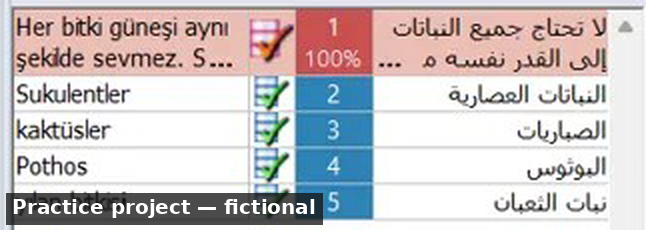
A flag instead of a fix
One section advises keeping plants away from radiators in winter — sound advice for a cold climate, but not something that fits a Gulf audience the same way. Rather than rewrite it myself, I left a translator's note in the file explaining the mismatch and asking whether the client wanted it adjusted for specific markets. That's the brief's instruction ("flag it, don't silently change it") in practice, and it's also just how I'd handle a genuine regional question on a real project — the call belongs to whoever owns the content, not to me.

What this practice round reinforced for me: MT is a mixed bag even within the same short text — sometimes it lands better than my own first pass, sometimes it flattens exactly the phrase that needed the most care. A glossary is only useful if I actually check against it at the end, not just while I'm translating, and even then, deviating from it is a conversation to have with the client, not a decision to make alone. "Light localization" has a real edge to it — deciding what to flag versus what to quietly fix is its own skill, separate from the language work.
If you're curious about my Business Written Translation, Content Translation, or Proofreading & Editing services, you can find details on my homepage.
Here is the link for the Appendix:


Comments