MTPE Practice Project: From Raw MT to Natural Turkish

Disclaimer: This is a fictional portfolio/practice project created for skills development. Spine & Ink is a fictional bookstore and is not a real client. The English source text was written for this exercise, and the Turkish machine-translated draft was generated using Microsoft Translator via the Bing/Microsoft translation interface. No client material or confidential content was used. The purpose of this project is to show my approach to machine translation post-editing (MTPE), proofreading and editing, linguistic QA, adaptation, terminology, and target-language quality control.
Why I created this project
Machine translation can provide a useful starting point, but a usable translation often requires much more than correcting obvious grammatical errors.
For this practice project, I wanted to examine what happens when a relatively short piece of English bookstore web copy contains different types of language challenges: informal expressions, humor, cultural references, idioms, metaphors, website terminology, customer-facing copy, product descriptions, and newsletter content.
Rather than translating the English directly into Turkish myself, I deliberately created a raw machine-translated baseline first.
I then treated that output as a working draft and went through it the way a translator and editor would: identifying problems, considering the intended audience and function of each segment, weighing alternatives where necessary, and making decisions based on meaning, context, tone, naturalness, and target-culture expectations.
The result was not intended to be a word-for-word reproduction of the English. The goal was a Turkish text that could plausibly be read by a Turkish audience as natural bookstore web copy.
My Machine Translation Post-Editing Workflow
I followed a simplified human-in-the-loop translation workflow:
English source → Raw machine translation → MTPE → Linguistic QA → Cultural adaptation → Proofreading & revision → Final Turkish version
The stages were not always completely separate. In practice, translation, editing, adaptation, and QA can overlap. However, separating them conceptually helped me understand why I was changing something.
1. Raw machine translation
First, I translated the English source using Microsoft Translator via the Bing/Microsoft translation interface. I intentionally preserved the output rather than correcting it immediately — this gave me a fixed machine translation baseline.
2. MTPE
I then reviewed the machine-translated text sentence by sentence, looking for:
mistranslations
unnatural Turkish
literal translations of idioms
incorrect word choices
grammatical and syntactic problems
ambiguity
inappropriate register
terminology problems
cultural references
formatting issues
missing or distorted meaning
3. Linguistic QA
After the main post-editing, I checked the text again for:
consistency
punctuation, capitalization
numbers, dates, time formatting, currency
terminology
headings
sentence structure and tone consistency
readability
remaining traces of machine-translated phrasing
This was linguistic QA as part of a practice project, rather than a formal production QA scorecard with severity levels and weighted error categories.
4. Cultural adaptation
Some problems couldn't be solved simply by correcting the machine translation. Certain expressions required me to ask:
"How would a Turkish reader naturally understand this?"
rather than:
"How can I translate these English words?"
Looking at the raw machine translation
The raw output wasn't unusable — many parts communicated the general meaning correctly. But several segments were grammatically possible but stylistically unnatural, while others needed contextual or cultural adaptation.
Source
"Turns out the smell goes away. The books didn't."
Raw MT
"Meğerse koku gidiyor. Kitaplar gitmedi."
The basic meaning is understandable, but the sentence doesn't produce the same effect in Turkish. The English works because of its very short contrast — the smell goes away, the books didn't — and after considering a few options, I settled on:
"Koku geçti. Kitaplar kaldı."
This is short, natural, and preserves the understated humor. The important point here is that I wasn't trying to preserve the exact English grammar — I was trying to preserve the effect.

Idioms and expressions: translating the meaning, not the words
One recurring issue in machine translation was the treatment of idiomatic English.
Source
"a garage full of boxes we couldn't bear to throw out"
Raw MT
"atmaya kıyamadığımız kutularla dolu bir garaj"
Interestingly, this was one of the cases where the machine translation was already quite natural. I kept it as-is because "atmaya kıyamamak" is an established Turkish expression that captures the emotional reluctance behind couldn't bear to throw out.
This was a useful reminder that MTPE isn't about changing everything simply because the output came from a machine. If the machine translation is already appropriate, there's no reason to rewrite it unnecessarily.
Preserving the function of an expression
Source
"Half the fun of a used bookstore is not knowing what you're going to walk out with."
Raw MT
"İkinci el bir kitapçının yarısı, ne ile çıkacağınızı bilmemekle ilgilidir."
The raw version follows the source structure too closely. "Half the fun" doesn't mean that exactly half of the enjoyment is mathematically attributable to this one thing — it needed a natural Turkish equivalent expressing one of the best parts. My final version:
"İkinci el bir kitapçıda işin en güzel yanı da, sonunda elinizde neyle çıkacağınızı hiç bilmemeniz."
This preserves the meaning, the casual tone, the image of leaving the shop with an unexpected book, and the conversational character of the original — without reproducing the English syntax.
"Top dollar" and contextual meaning
Source
"Just don't expect top dollar for that water-damaged copy of a diet book from 2004."
The machine translation leaned on a more literal idea of a high payment. But "top dollar" is idiomatic for the highest or a very high amount of money, and the context was a friendly used-bookstore website, so I chose:
"Yalnız, 2004 tarihli, su almış o diyet kitabı için yüksek bir fiyat beklemeyin."
I avoided an overly technical or dictionary-style equivalent — the goal was to make the sentence sound like the bookstore had written it itself. I also changed "water-damaged" to "su almış" rather than a more technical-sounding "su hasarlı." Small example, but it illustrates something important: a dictionary-equivalent expression isn't automatically the best contextual translation.
Humor and tone
The fictional bookstore has a recognizable personality: informal, slightly humorous, friendly, not overly polished. That tone had to stay consistent.
Source
"Some things really are past saving."
Raw MT
"Bazı şeyler gerçekten kurtarılamaz."
Understandable, but neutral and a little mechanical. I chose:
"Bazı şeylerin artık kurtuluşu yok."
Same meaning, but the Turkish sounds more conversational and fits the bookstore's voice better.
Web conventions
Not every decision involved a machine translation error — some involved choosing the normal Turkish web convention.
Source
FAQ
I used "SSS (Sıkça Sorulan Sorular)" rather than keeping the English acronym.
Source
Do you have a mailing list?
The machine translation didn't quite capture what was being asked. The source asks whether the bookstore has a mailing list — not whether the customer can join it. I chose:
"E-posta listeniz var mı?"
That distinction matters.
"Hover" and natural Turkish expressions
Source
"The guy at the counter didn't try to upsell me or hover…"
Rather than a technical translation of upsell or a literal rendering of hover, I chose:
"Kasadaki görevli bana bir şeyler satmaya çalışmadı ya da başımda durmadı…"
"Başında durmak" exists naturally in Turkish and fits the context. I considered a stronger alternative — "başımda dikilmedi" — but that can sound more negative or intrusive. "Başımda durmadı" was softer and better suited to a positive customer testimonial: a decision based on register and tone, not just dictionary meaning.
Metaphor and adaptation
Source
"Feels wrong to erase someone else's fingerprint on a book about wandering."
A literal translation of "fingerprint" would sound strange in Turkish, since the word is used metaphorically here. I chose:
"Başka birinin izini, yolculuklar üzerine bir kitaptan silmek bize doğru gelmedi."
"İz" preserves the metaphorical idea of a previous owner's trace or presence without forcing the English metaphor into an unnatural Turkish expression — preserving the intended image and emotional effect rather than the exact lexical form.
"Trade in" and commercial meaning
Source
"$8, or $6 if you trade in two paperbacks toward it."
A more literal translation could easily turn awkward or overly transactional. After considering alternatives, I chose:
"8 dolar; iki ciltsiz kitabınızı getirirseniz, bu kitap size 6 dolara gelir."
Concise, immediately understandable, and closer to the bookstore's conversational style than a more technical phrasing.
Cultural references
The source included several culture-specific references: Antiques Roadshow, estate sale, Christmas Day, cider, and dollar cart. These can't always be handled with a word-for-word translation.
Antiques Roadshow
I kept the name Antiques Roadshow as-is rather than translating the program title:
"...biz ikinci el kitapçıyız, Antiques Roadshow'daki nadir kitap satıcıları değil."
The important thing here is knowing when a proper name should stay a proper name.
Estate sale
One of the harder cultural terms — there's no single Turkish word that automatically communicates the same cultural practice. I considered "ev tasfiyesi satışı" but found it fairly technical, and landed on the more accessible "ev boşaltma satışı." I logged the reasoning as a translator's note directly in the file, since it's the kind of decision a reviewer or future editor would want visibility into:
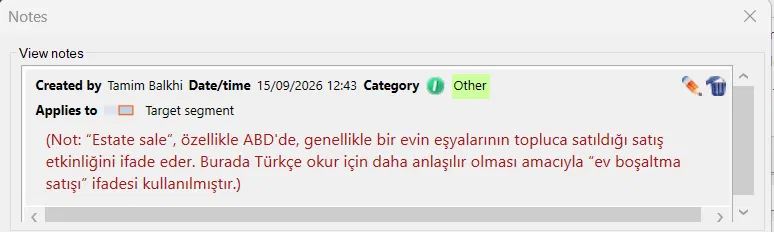
The lesson here: adaptation sometimes means explaining or approximating a cultural concept, rather than assuming a perfect lexical equivalent exists.
Cider
"Cider" turned out to be genuinely ambiguous — in English it can mean an alcoholic drink or a non-alcoholic one, depending on context, and the source didn't make it clear which was meant at this neighborhood spring market. I went with "elma şarabı" (the alcoholic reading) as a reasonable interpretation for the setting, but rather than treat that as a settled fact, I documented it as a judgment call:

This is a small habit, but it's the kind of thing that matters in a real workflow: flagging where a term was genuinely ambiguous, rather than presenting a guess as if it were certain.
"See you between the shelves"
Source
"That's it. See you between the shelves."
A literal translation would be unnecessarily rigid. My final version:
"Hepsi bu kadar. Rafların arasında görüşürüz."
Short, natural, and it sounds like something a small bookstore would actually write.
Before and after: a few examples
Source / raw MT issue | Adjusted Turkish | Main reason |
"The books didn't." → "Kitaplar gitmedi." | "Kitaplar kaldı." | Preserves the short humorous contrast |
"Half the fun…" → "kitapçının yarısı…" | "işin en güzel yanı…" | Natural Turkish expression |
"top dollar" | "yüksek bir fiyat" | Contextual rather than dictionary-style translation |
"water-damaged" | "su almış" | More natural for a used-book context |
"mailing list" | "E-posta listeniz" | Correct function and Turkish web usage |
"hover" | "başımda durmak" | Natural expression, appropriate register |
"fingerprint" | "iz" | Preserves the metaphor without sounding literal |
"trade in two paperbacks" | "iki ciltsiz kitabınızı getirirseniz…" | Natural commercial wording |
"See you between the shelves" | "Rafların arasında görüşürüz." | Preserves the imagery and tone |
What this exercise showed me
The human post-editing stage involved questions like:
Is this grammatically correct, and is it natural in Turkish?
Does it express the intended meaning, and does it fit the context?
Does it sound like the intended speaker, in the right register?
Would a Turkish reader recognize the cultural reference?
Should this proper name be translated, or kept as-is?
Should this metaphor be preserved, changed, or replaced?
Is there a more natural Turkish idiom for this?
Does the sentence still do the same job as the English one?
These go beyond correcting spelling or grammar.
MTPE is not just "fixing bad machine translation"
One of the clearest lessons from this project: MTPE doesn't mean rewriting every machine-translated sentence. Some segments were already fine as-is. Others needed:
minor grammatical correction
lexical replacement
syntactic restructuring
idiomatic adaptation
cultural adaptation
tone adjustment
terminology decisions
complete rephrasing
The amount of intervention depended entirely on the segment. An attentive post-editor should be able to tell the difference between "this is wrong" and "this is technically understandable, but it isn't how a Turkish reader would naturally encounter this content." That second category was the more interesting one in this project.
Adaptation versus translation
This exercise also showed why adapting content for an audience is broader than simple word-for-word substitution. The source was fictional bookstore content aimed at customers, which meant the Turkish version needed to work as Turkish web copy — not just a bilingual mirror of the English. Small decisions like:
FAQ → SSS (Sıkça Sorulan Sorular)
mailing list → e-posta listesi
10am to 7pm → 10.00–19.00
add up to content that feels like it belongs to the target audience, rather than content that's obviously been translated for them.
Adaptation doesn't mean freely rewriting the source, though — the goal is still to preserve meaning, intent, tone, function, information, and personality. What changes is how much the target-language wording has to shift to get there. "Half the fun…" became "İşin en güzel yanı…" — different words, same communicative function. "The books didn't." became "Kitaplar kaldı." — different wording, same joke and contrast.
Terminology and consistency
Even in a short fictional website project, terminology consistency matters. I kept an eye on recurring concepts — bookstore, used/secondhand, book, paperback, newsletter, shelf, customer, return, opening hours — and how they'd be understood consistently across different content types. A translation can be grammatically excellent and still feel unpolished if terminology shifts unnecessarily between sections.
I built out a small termbase alongside the post-edit so these choices stayed locked in rather than being re-decided segment by segment:

Proofreading and final review
After the main MTPE stage, I planned a separate proofreading and review pass — important because a translator can get too close to their own wording. For that pass, I'd check:
Language — grammar, spelling, punctuation, sentence flow, word choice, naturalness Consistency — terminology, headings, capitalization, punctuation conventions, numbers, dates, times, currency Adaptation — cultural references, web conventions, target-audience expectations, idioms, metaphors, tone Quality — accuracy, completeness, readability, fluency, consistency, appropriate register.
The objective isn't to make the translation different from the machine translation for its own sake — it's to make the final text fit for its intended purpose and audience.
What I learned from the project
Context determines translation choices. A phrase can't always be translated correctly in isolation — the same English word or expression may need different Turkish solutions depending on context, audience, genre, register, and purpose.
Naturalness matters. A sentence can be grammatically understandable and still sound translated. Post-editing requires attention to how Turkish is actually used, not just whether it's technically correct.
Not every problem is grammatical. Some of the most important changes in this project involved humor, idioms, metaphors, cultural references, tone, and web conventions — none of which show up in a basic grammar check.
Human judgment still matters. Machine translation gives a useful first draft, but deciding whether an expression fits a specific audience still takes human evaluation.
Good MTPE is selective. The question should always be: does this change improve accuracy, naturalness, consistency, readability, tone, or fit for the target audience? If the existing translation already works, keeping it is the right call.
Final result
The final Turkish version came together through Machine Translation + Human Post-Editing + Linguistic QA + Cultural Adaptation + Proofreading & Revision.
The fictional nature of the project is intentional — I wanted to show not just what a finished translation looks like, but the decision-making behind it. For me, the most useful part of this exercise wasn't spotting mistakes in machine translation — it was learning to identify why a particular wording works better for a Turkish audience, and when to preserve, modify, adapt, or fully restructure a machine-generated sentence. That's the part of translation work that doesn't reduce to comparing two sentences word by word.
Business Written Translation, Content Translation, and Proofreading & Editing — I help businesses in Türkiye and beyond with careful, natural-sounding translation for their own content.
Want to see the complete source and final Turkish text? Here's the full version →


Comments