Behind the Words: What Actually Happens When I Build a Translation Term Base

Most people picture translation as a straight line: read the English, write the Arabic, done. In practice, a good chunk of the real work happens somewhere else entirely — in the small decisions that never make it into the final sentence, and in catching the ones that almost do.
I recently ran a full EN→Arabic practice project on a real company's "About Us" page — vision and mission statements, a sector overview, and a long company history section. Here's the whole arc: where the source text came from, why I started with a machine translation draft instead of translating from scratch, what it took to make that draft actually sound like Arabic rather than translated English, and then — once the sentences were right — the quieter work of building a term base and catching what a QA tool does and doesn't understand.
Put it in another way, this project was machine translation post-editing (MTPE) and linguistic QA end to end — two areas I'm actively building toward as a specialization, not just a one-off exercise.
Finding something real to translate
Practice material is only useful if it resembles what an actual client would send. I didn't want a textbook paragraph written for language learners — I wanted the register, structure, and terminology density of something a real business would actually hand a translator. So I pulled the Vision & Mission, Sector Overview, and History sections directly from a real airline company's public "About Us" page: real corporate register, real statistics, a long narrative history section with dates, named individuals, and technical aviation terms. Nothing simplified for the exercise.
That choice mattered later. A cleaner, textbook-style paragraph wouldn't have produced half the terminology decisions or grammar traps that show up further down in this post — those only surface in text that was never written with a translator in mind.
Starting from a machine translation draft
Rather than translating from a blank page, I ran the English through DeepL first and used that as a starting draft. That's not a shortcut to avoid the real work — it's closer to how a lot of professional post-editing actually happens, and it's a skill in its own right: knowing what a machine translation engine tends to get right (terminology, basic sentence meaning) and where it reliably needs a human pass (register, word order, idiom, anything culturally specific).
The DeepL draft was accurate in the sense that every sentence meant roughly what the English meant. It was also, in a lot of places, obviously translated — grammatically valid Arabic that no one would ever actually write, because it mirrored English's sentence shape instead of Arabic's.
Making it sound like it was written in Arabic, not translated into it
This was the longest part of the project, and the part that never shows up as one clean "before and after" — it was dozens of small adjustments, each solving a different kind of problem.
Word order. Arabic prose generally reads more naturally verb-first, while the DeepL draft frequently kept English's subject-first structure. A sentence about the company's founding, for instance, read fine but carried an English-shaped spine; restructured verb-first, the same sentence had the rhythm of something actually written in Arabic rather than run through a translator.
Sentence-level literalism. Some phrases translated correctly word-for-word but landed oddly. A line about a "truly unforgettable experience" had DeepL tack on a literal "truly" at the end of the Arabic sentence — technically correct, but Arabic doesn't need an intensifier bolted onto an adjective that's already doing the work. Dropping it made the sentence read as confident rather than translated.
Metaphors that don't survive the trip. English can get away with a poetic image — "meals above the clouds," for example — that just reads as vague once translated literally into Arabic. The fix wasn't a cleverer translation of the metaphor; it was dropping it and stating the idea plainly, since Arabic corporate writing doesn't reach for the same kind of whimsy English does in that spot.
Restructuring for narrative flow, not just sentence-by-sentence accuracy. The DeepL draft was accurate sentence by sentence, but a "company history" section reads better as flowing narrative than a list of individually correct facts. Two adjacent English sentences about the company's founding date and its 90-year track record became one merged Arabic sentence with a proper narrative arc, rather than two short, choppy statements that happened to sit next to each other.
Catching plain typos. A few one-letter slips made it through the first pass — the kind that look almost right on a fast read. One turned "due to" into something closer to "prefers," because a single incorrect letter changed the meaning of the whole verb. Another swapped a real conjugation for one that doesn't exist in Arabic. Neither would trip an obvious alarm; both needed a slow, deliberate re-read to catch.
None of that stage produced screenshots worth sharing — it happened as a long back-and-forth over the actual sentences, not inside any particular tool. But it's the stage that decides whether a translation reads as translated or reads as written, and it's why the terminology work that follows actually mattered: none of it would matter if the surrounding sentences still sounded like a machine wrote them.
Building the Translation Term Base: Starting with the Obvious Terms
Once the sentence-level work was in a good place, I moved the project into memoQ and started building a term base — a running record of every term decision, so I wouldn't reinvent the same word three segments later or lose track of a decision I'd already made once.
Every project has a batch of terms that show up early and repeat often. In this one: aviation sector, profitability, year-on-year, pre-pandemic levels. Once I translate a term once, I don't want to reinvent it three segments later, so it goes into the term base immediately, before momentum carries me past it.
Terms getting flagged and matched as I move through the sector overview. Adding "aviation sector," "profitability," and "year-on-year" to the term base as they come up. "Pre-pandemic levels" added — small phrase, but one I wanted locked in early since it reappears late
Two words for one English word
The pandemic period looks like a straightforward phrase to translate, until I actually stopped to ask: which word? Arabic has two real options here, and they're not interchangeable. "الوباء" is the generic word for an epidemic or outbreak in general. "الجائحة" is the term that's become specifically associated with COVID-19 in professional and media Arabic. The English source doesn't specify, but the context (a document written well after 2020, discussing "pre-pandemic levels") makes it clear which event is meant. Picking the generic word here wouldn't be wrong exactly, but it would read as vaguer than the source intends, and it wouldn't match how this specific event actually gets referred to elsewhere in professional writing.

The one-letter mistake I almost let through
This is the one that worried me most, precisely because it was so easy to miss. In a sentence introducing Turkish Airlines' first chief executive, the English calls him "Türkiye's first aviator." The Arabic words for "aviation" (طيران) and "aviator" (طيّار) are one letter apart. Typing the wrong one doesn't produce a nonsense sentence — it produces a sentence that reads fine on a fast pass, just slightly wrong: "Turkey's first flight and chief executive" instead of "Turkey's first aviator and chief executive." Nothing about that error trips an alarm. It just quietly says something different than intended.
The only way I caught it was reading the sentence slowly, out loud, and asking whether every word was actually doing the job the English word was doing — not just whether it looked plausible.

That same sentence had a second, unrelated problem worth mentioning: the phrase "its chief executive" uses a possessive pronoun that, in Arabic word order, ended up sitting closer to "Turkey" than to the actual thing it was supposed to refer to (the airline administration mentioned earlier in the sentence). Grammatically defensible, but a reader's first instinct would be to attach the pronoun to the wrong noun. The fix wasn't a different word — it was reordering the clause so the name leads and the pronoun has only one plausible thing nearby to refer to. Same words, different arrangement, no more ambiguity.
When the tool flags something that isn't actually wrong
Not every warning memoQ throws is a real error, and telling the difference is its own skill. One sentence includes "the 20th of May 1933." memoQ's QA flagged a number mismatch here — but the actual issue was that English's "20th" (an ordinal, digits plus letters) doesn't have a character-for-character equivalent in Arabic, which just writes "20 مايو" with no ordinal suffix. The tool couldn't match "20th" to "20," and that one failed match cascaded into flagging several other numbers in the same sentence as suspicious, even though they were all correct.
The fix here wasn't to change my translation — it was to verify manually that every number was actually accounted for, then mark the warnings as reviewed rather than blindly dismissing them or, worse, distorting the Arabic to satisfy a tool that was checking the wrong thing. Same logic applied later to a sentence mentioning "the 80's" — Arabic naturally spells decades out as words ("الثمانينيات") rather than digits, which the QA tool also couldn't recognize as equivalent to "80."
Knowing when a warning is protecting you and when it's just a blind spot in the tool's logic is as much a part of the work as the translating itself.

Fixing a sentence that had no verb
One sentence describes an airport that "became Atatürk Airport, a global meeting point." An early pass at the Arabic dropped the verb "became" and just stacked the two descriptive phrases next to the airport's name, hoping the reader would infer the connection. The result technically had all the right words, but no grammatical anchor tying them together — and in Arabic, dropping the governing verb also breaks the case agreement on the words that were supposed to depend on it. It read like a caption, not a sentence.
The fix was to restore "أصبح" (became) at the front of the clause, which fixed two problems at once: it gave the sentence an actual grammatical structure, and it automatically corrected the case marking on the words that now properly depended on it. Sometimes the fix for "this sounds a little off" isn't a better word choice — it's noticing that a word got dropped that the whole sentence structurally needed.
The inconsistency my own term base caught
Partway through, I noticed something: some Arabic terms had the definite article "ال" attached, others didn't, with no real logic to which. Piston engines and jet-powered aircraft had it; fleet didn't. This isn't just a style inconsistency — it actually breaks term matching. A term base entry stored with an unnecessary article only matches source text where that exact article happens to appear in exactly that position, which defeats most of the point of building a term base in the first place. The fix is to store the bare, dictionary form of a term, not whatever form it happened to take the first time I typed it.
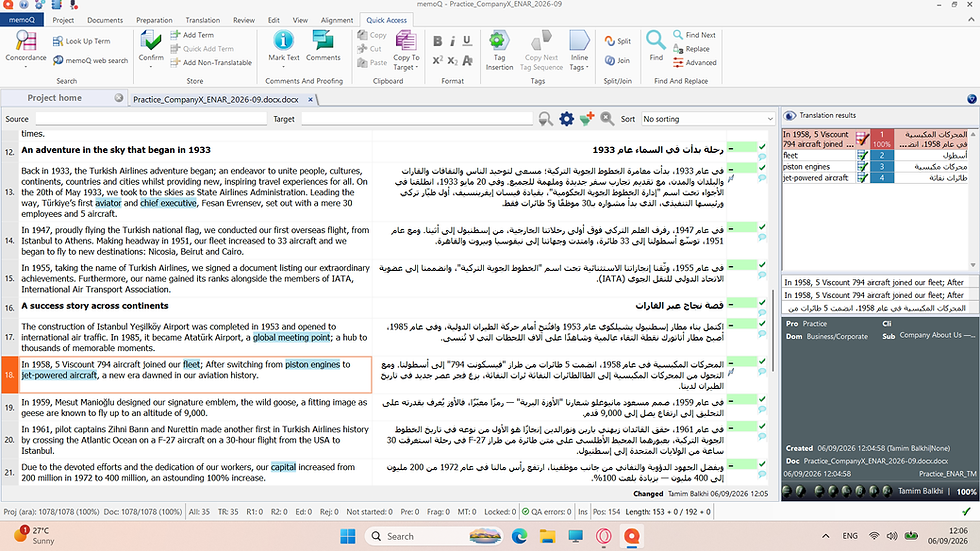
Same fix applied to e-tickets and corporate website a few segments later — and one exception worth noting: capital, as a financial term, conventionally keeps its article in Arabic the way "the GDP" would in English. Knowing which rule applies where mattered more than applying one rule everywhere.
"Capital" — a case where keeping the article was actually correct, unlike the ones above. E-tickets and corporate website, cleaned up to match the same bare-term standard.
The pun that doesn't translate
The English source mentions meals "specially made by the flying chefs." My first instinct for a literal-sounding Arabic equivalent was close to "chief of pilots" — which is a real trap, because that phrase reads as referring to senior aviation staff, not the people cooking the food. The English is doing quiet wordplay ("chef" plus "flying"), and Arabic doesn't have a natural equivalent pun sitting there waiting to be used.
I went through a few options before settling on one: a literal "flying chef" translation that sounded unusual on its own, a more poetic "chefs of the skies" that felt like it was reaching for a branded tone the rest of the document didn't have, and finally a plain "onboard chefs" — which gives up the wordplay entirely but is immediately clear and doesn't risk being misread. Clarity won over cleverness here, mostly because the cost of being misunderstood (readers picturing pilots) was higher than the cost of losing a small pun.
Mobile application — a clean, uncontroversial entry. Customer satisfaction — same.
Dropping a metaphor that doesn't survive translation
Related problem, same sentence: delicious meals above the clouds. English can get away with a poetic "above the clouds" — it's a familiar, slightly whimsical image. Translated literally into Arabic, it just reads as vague; the phrase doesn't carry the same charm and mostly just raises the question "above the clouds how, exactly?"
I considered three directions: keep the poetic image using a classical Arabic phrase for "high in the sky," which read as more literary than the rest of the document warranted; describe the altitude concretely ("at a height of thousands of feet"), which felt like it was trying too hard to compensate; or just drop the metaphor and say "onboard," which is what I went with. Sometimes the most natural translation is the one that gives up the flourish the source language could afford but the target language can't carry gracefully.

The frequent-flyer program term in that same segment had its own small decision behind it. A direct-feeling translation put "loyalty" as the grammatical centerpiece of the phrase — technically accurate, but it describes the concept rather than naming the actual product the way an airline would refer to it. Arabic airline sites consistently use a specific standard term for this, and matching that existing convention mattered more here than being independently accurate, since the whole point of the phrase is that a reader recognizes it instantly.
A claim that quietly disappeared
Youngest fleet and most modern fleet are two separate claims in the English — one about the age of the aircraft, one about their technology. An early draft of the Arabic collapsed both into a single "most modern," accidentally saying the same thing twice and silently dropping half of what the source was actually claiming. Nothing about the sentence looked broken; it just quietly said less than it was supposed to.
Catching that meant not just reading the Arabic on its own, but checking it line by line against exactly what the English asserted — not roughly, but claim by claim.

A smaller version of the same problem showed up in fun-filled journey in that same sentence: one of the words I considered leaned toward "thrilling" or "suspenseful" rather than "fun," which would have quietly shifted the tone from cozy and reassuring to something closer to an adventure ride. Same category of mistake as the fleet issue — not wrong exactly, just not saying what the source was actually saying.
"Youngest and most modern fleet" — split back into two distinct claims once I caught the overlap. Best Airline in Europe, sponsorships, and advertisements — closing out the term base for this projec
Why this matters more than it looks like it should
None of this shows up in a finished translation. A reader just sees fluent Arabic and moves on. But every one of those screenshots represents a moment where the sentence could have gone a slightly different way — a dropped verb, a misplaced pronoun, a pun that doesn't cross languages, two claims accidentally folded into one — and where catching it took slowing down rather than moving faster.
That's the actual work, most days: not finding the words, but noticing exactly where a word, a structure, or a tool's warning is quietly telling you something's off, then deciding what to do about it — and making sure that decision holds for every future sentence that needs it too.
If a document translated into Arabic needs to actually sound like it was written for an Arabic reader, not translated at them, that attention to individual decisions is where that comes from. I help businesses in Türkiye and beyond with Business Written Translation, Content Translation, and Proofreading & Editing — if that's something you're weighing for a project, feel free to reach out.
A note on this piece: this was a practice project, not client work, and the translation may still carry a few minor imperfections. I put a genuine amount of effort into making it read as natural and contextually appropriate for an Arabic audience — not just accurate, but actually right for the tone and register the content called for. It took far more work than I expected going in, but I think it was worth it.


Comments