Turkish → Arabic MTPE & Linguistic QA Practice: Corporate AI Governance Policy

A practice project. Not client work, not commissioned, not affiliated with or endorsed by the company whose policy inspired the exercise — I'm keeping that company unnamed here on purpose, since the point of this post is the process, not the document.
I recently ran myself through a full post-editing workflow from start to finish, using a real Turkish-language corporate AI governance and ethics policy as source material. I put the Turkish through Microsoft Bing Translator to get a raw machine translation into Arabic, then opened it in memoQ and worked through it as if it were a real MTPE/LQA assignment: comparing the raw MT against the Turkish source, editing for accuracy and register, building a termbase as I went, and finishing with a full QA pass.
"I do MTPE and LQA" is a much smaller sentence than the process behind it, so here's what that process actually looked like.

Turkish-Arabic MTPE: What Raw MT Gets Right, and Where It Breaks
Bing's raw output was more competent than I expected for a formal legal-style Turkish text — it handled long noun phrases reasonably and mapped the section structure correctly. But three categories of problems came up, and they call for different kinds of fixes.
1. Actual comprehension failures. The document defines its own parent-group term as "all companies controlled — directly or indirectly, individually or jointly — by [the parent entity], plus the joint ventures listed in its consolidated financial report." Bing's raw output garbled this: it rendered the parent entity's name twice, as if the source were naming two separate organizations, and lost the actual controlling relationship in the process. That's not a style problem — the MT misparsed the underlying legal relationship in its own defined term. Fixing it meant reconstructing the logic of the sentence, not just smoothing the Arabic.
2. Scope-of-modification errors. The opening purpose clause lists six actions (developing, supplying, integrating, using, monitoring, and retiring AI systems), all meant to be governed by one shared manner phrase: "ethically, safely, responsibly, transparently, and in compliance with regulation." Bing attached that manner phrase only to the first item in the list and left the other five ungoverned — a common MT failure with long coordinated lists in Turkish, where the engine loses track of which phrase modifies the whole list versus just the nearest verb. The fix was moving the manner phrase to sit after the full list, so it reads as governing all six actions the way the Turkish intends.
3. Terminology drift. This was the most persistent issue, and the most useful one to catch, because a straight read-through can miss it if you're not actively tracking defined terms. A few examples from this document alone:
The policy's own title uses a Turkish word for "governance." Bing translated it one way in the title and a different Arabic word — closer to "administration/management" — one paragraph later, referring to the same policy by name.
The document's core recurring term, "AI Systems," alternated between two different Arabic plurals depending on which section Bing was translating.
A formally defined recurring process ("Preliminary Assessment") came out three different ways across the document.
The risk-classification tables used one Arabic word for "risk level" in one table and a different one in the very next table, for the identical Turkish source term.
None of these are "wrong" in isolation — each is a reasonable rendering on its own. The problem is that a policy document depends on defined terms staying identical everywhere they appear. Fixing this meant picking one Arabic term per Turkish concept and applying it everywhere, which is really a termbase problem rather than a sentence-by-sentence one.
Decision-making: why I chose what I chose
A few edits weren't fixing errors so much as making a judgment call between two acceptable options — and the reasoning matters more than the final choice.
Choosing "governance" over "administration." Both are defensible dictionary equivalents for the Turkish term. I went with the Arabic word closer to "governance" because that's the term Arabic corporate-compliance documents actually use for this concept — "administration" reads more like day-to-day management, which understates what the policy is doing: setting up an oversight and accountability structure, not just running operations.
Adding the defined-term introduction convention. When the policy first introduces itself — "the [Policy Name] ('the Policy')" — Turkish just puts the short form in quotes with no connector. Arabic legal drafting almost always adds a preposition meaning "referred to as" when introducing a defined term this way. Bing's literal version wasn't wrong exactly, it just didn't read like a document drafted natively in Arabic legal register.
Recasting an awkward collocation. One clause literally translates as the policy "supports the education of stakeholders, children, and youth" on a topic. A literal Arabic rendering would collocate awkwardly. I recast it using the natural Arabic pairing for "training [someone] in/on [a subject]." This one's less a fix than a naturalization choice — the MT wasn't inaccurate, just not idiomatic.
I'd call the first two closer to adaptation for register — matching the conventions of Arabic legal/compliance writing — and the third closer to natural-language editing than anything I'd call localization in the fuller sense. There's no cultural substitution happening here, just fitting the target language's own drafting habits. Worth naming precisely, since a compliance document like this doesn't call for localization the way marketing copy would.
The termbase: catching my own inconsistency, twice
I pulled the recurring terms — defined terms, section headers, risk categories — into a termbase as I worked, standardizing on single Arabic renderings so memoQ would flag it automatically if I drifted later in the document.
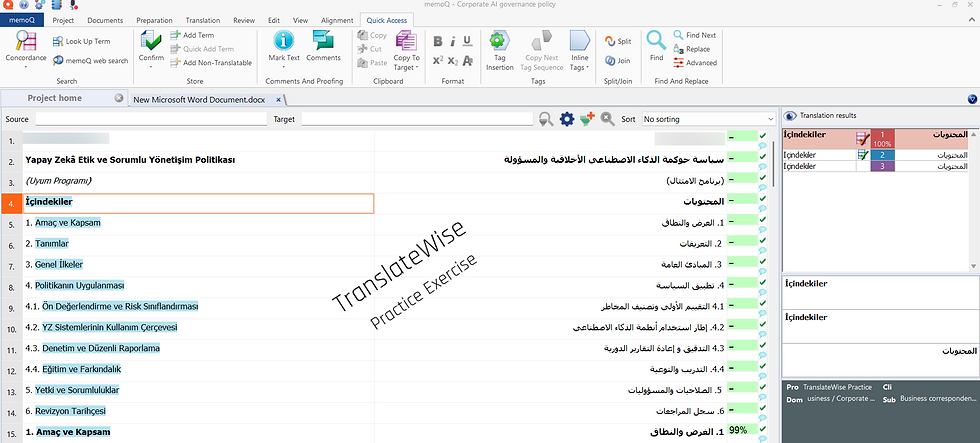
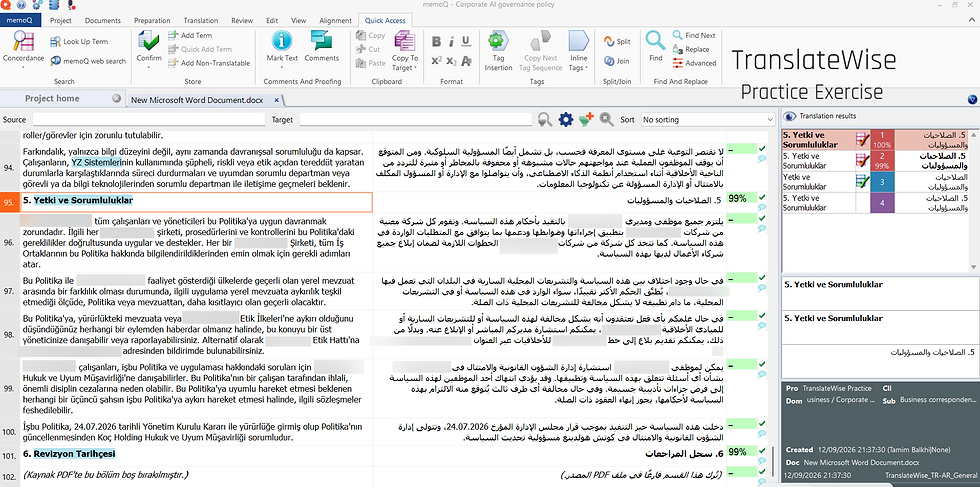
Termbase matches for the risk-classification term, standardized to one Arabic rendering. Termbase check for an AI-system category term — consistent across every segment.
And it caught something on my end, too: after importing terms from a spreadsheet, the termbase briefly ended up with two competing entries for the risk-level term — one correct, one carrying over the earlier inconsistency I'd already fixed in the text. It had gotten re-added, probably auto-confirmed before I'd fully settled on one rendering. I caught it by watching the term-match panel rather than the segment text, which is really the point of keeping the termbase visible while you work — it surfaces inconsistency you'd otherwise only catch by re-reading the whole document. I deleted the stray entry and re-confirmed so the termbase agreed with itself.
What this actually was: MTPE, LQA, and the smaller true category — adaptation
If I sort what I did into categories:
MTPE covered the raw mechanics — fixing the comprehension error, the scope error, and picking consistent Arabic terms for the recurring source terms.
LQA was the systematic pass afterward: checking consistency against the termbase, verifying defined terms matched their own definitions elsewhere in the document, and running the final QA check in memoQ.
Adaptation was the smaller, real category — the legal-drafting conventions and idiomatic recasting described above. I'm being deliberately careful not to call this "localization," since that term usually implies something broader (product UI, marketing copy, cultural substitution) than what a compliance policy actually needs — and it's not a service I currently offer.
None of this required inventing anything — every fix traces back to a specific, identifiable gap between what the Turkish source said and what the raw MT produced. That's the part I found most useful about doing this as a full document rather than a handful of curated examples: the termbase-level problems only show up when you work through something end to end, not a few selected sentences.
Those same habits — consistent terminology, catching what a first pass misses, checking a sentence's logic rather than just its surface — carry over into the Business Written Translation work I do.


Comments