English to Arabic Translation Process: A Real Walkthrough

A few days ago I sat down with a short investor-style piece — the kind of confident, numbers-heavy corporate copy you'd find in an annual report or an investor briefing — and and ran it through a full English to Arabic translation process in memoQ. On the surface, that sounds simple: read the English, write the Arabic. In practice, almost every sentence involved a small decision, and I wanted to walk through a few of them here, because I think this is the part of translation that's easy to miss from the outside.
How the English to Arabic Translation Process Actually Starts
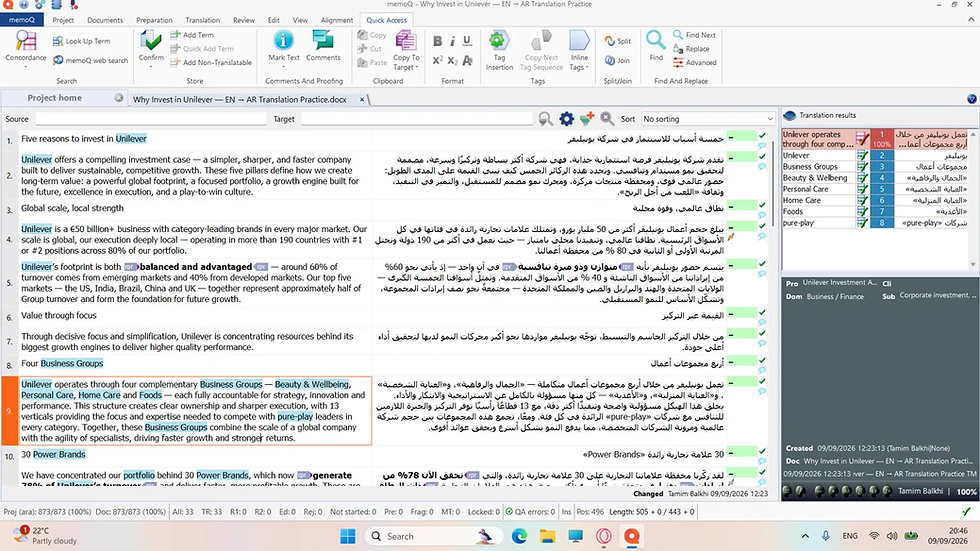
I began with a machine-translated draft rather than translating from scratch — this is a normal starting point in modern translation work, and the real work is what comes after: post-editing that draft against the source, sentence by sentence, checking not just whether it's correct, but whether it reads the way a native Arabic business reader would expect.
That distinction — correct versus natural — came up constantly. A phrase can be grammatically fine and still feel like it was translated, rather than written directly in Arabic. Catching that difference is most of what post-editing actually is.
A word that kept causing problems: "portfolio"
One word alone, "portfolio," came up close to ten times across the document, and it needed a different decision almost every time.
In Arabic, the direct word for "portfolio" (محفظة) is also the standard word for an investment portfolio. So when the source said something like "80% of our portfolio," translating that word on its own risked the reader momentarily reading it as a financial-assets claim instead of what it actually meant: the range of business categories Unilever competes in.
The fix wasn't one universal rule — it was reading each sentence on its own terms:
When the sentence was about business categories generally, I specified it as "محفظة أعمال" (business portfolio).
When it was specifically about brands, I specified "محفظة علاماتنا التجارية" (our brand portfolio).
In a couple of places, the surrounding sentence already made the meaning obvious enough that the bare word was fine.
Three different calls for the same English word, each depending on what that particular sentence needed.
Terms that stay in English on purpose
Some terms I chose not to translate. The source used a few named business concepts — "pure-play," a defined internal model the company calls "SASSY," and a couple of branded initiative names. These are the kind of terms a business-minded Arabic reader in this space would likely already recognize in their English form, the same way "IPO" often stays untranslated in Arabic financial writing.
Forcing an Arabic equivalent onto a term like that can actually make a document less clear to the exact audience it's written for, not more. So for these, I kept the original English, usually alongside a short Arabic gloss the first time it appeared, so a reader unfamiliar with the term still isn't lost.
Two catches worth mentioning specifically
"Premium potential." An early draft rendering of this leaned toward a general "excellent/distinguished" meaning. But "premium" here is doing a specific job — it's about pricing power, the ability to sell at a higher price point, not just general quality. Losing that nuance would have quietly changed what the sentence was actually claiming.
"Volume-led growth." The source is making a causal claim: growth driven by selling more units, as opposed to growth driven by raising prices. An early rendering flattened this into two separate ideas — "greater growth and volume" — which reads fine on its own but no longer says the same thing the source does. This is the kind of change a QA pass at the sentence level catches and a quick read-through often doesn't.

The consistency layer
Once the meaning-level decisions were made, I built a small termbase — a running record of the terms I'd locked in and why — so that memoQ would flag it automatically if any of those choices drifted somewhere else in the document. This turned out to matter more than I expected: a term I'd carefully reasoned through in segment 5 would sometimes resurface differently in segment 20, simply because it's easy to lose track of an earlier decision forty segments later. Catching that kind of drift is a normal part of the process, not a sign something went wrong.

What this actually shows
None of this was really about vocabulary. It was about reading each sentence for what it's actually claiming, then finding the Arabic that claims the same thing — for the audience that's going to read it. That's the part that doesn't show up when you just compare two finished paragraphs side by side.
A note on this piece: this document was a self-directed practice exercise, based on a publicly available style of investor-relations content, and was not produced for or on behalf of any client. I'm sharing the process here because I think how a translation decision gets made is often more interesting — and more useful to talk about — than the finished result.
If this is the kind of thinking you'd want applied to your own English-Arabic or Turkish business content, you can see how I approach that work on my Services page.


Comments